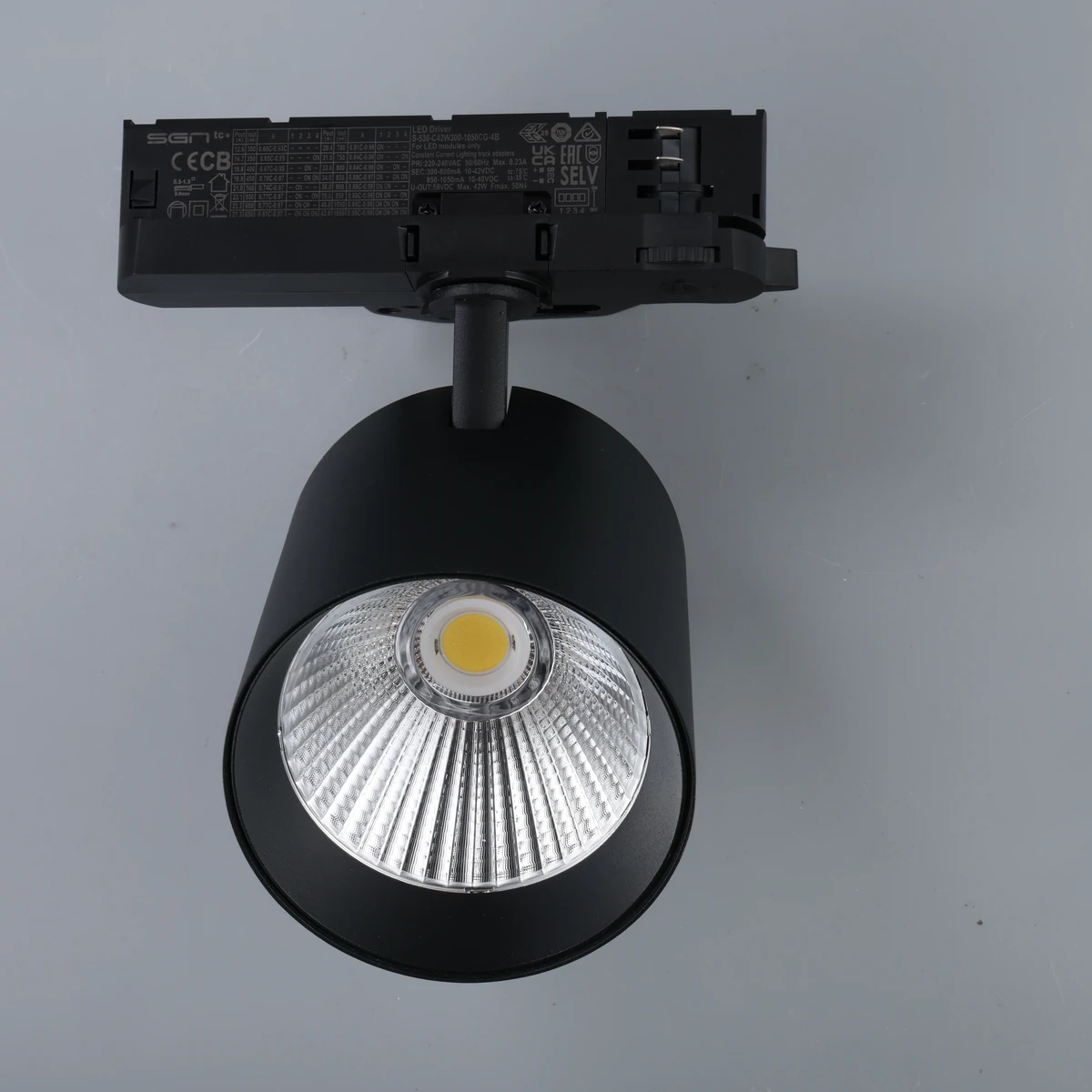
Beam angle is the spec most often left at “whatever the standard option is”, and the one that most reliably decides whether the finished install looks designed or accidental. It costs nothing to change at quotation stage and is expensive to fix after delivery.
What the number actually means
The beam angle is the cone within which intensity is at least 50% of the centre-beam value. Outside it the light does not stop; it falls away. The angle at which output drops to 10% is the field angle, and it is typically 1.5–2× the beam angle.
Two consequences follow:
- A 24° spot lights a noticeably larger area than 24° of geometry suggests.
- Two fixtures both labelled 24° can produce visibly different edges, because the shape of the falloff between 50% and 10% is not captured by the headline number. This is what the IES file is for — it describes the whole distribution, not one number.
The arithmetic
beam diameter = 2 × h × tan(θ ÷ 2)
where h is the distance from the fixture to the lit surface, not to the floor. For
a display plinth at 0.9 m under a 3 m ceiling, h is 2.1 m, not 3 m — a mistake that
routinely oversizes the optic by one step.
Beam diameter at a glance
Diameter of the 50% pool, in metres:
| Height | 15° | 24° | 38° | 60° | 90° | 120° |
|---|---|---|---|---|---|---|
| 2.5 m | 0.66 | 1.06 | 1.72 | 2.89 | 5.00 | 8.66 |
| 3.0 m | 0.79 | 1.28 | 2.07 | 3.46 | 6.00 | 10.39 |
| 4.0 m | 1.05 | 1.70 | 2.76 | 4.62 | 8.00 | 13.86 |
| 6.0 m | 1.58 | 2.55 | 4.13 | 6.93 | 12.00 | 20.78 |
| 8.0 m | 2.11 | 3.40 | 5.51 | 9.24 | 16.00 | 27.71 |
Three rules that cover most projects
1. Match the pool to the object, not the room
An accent light should produce a pool roughly the width of what it is lighting. A mannequin is about 0.8–1.0 m wide, which at a 3 m ceiling is a 15–24° optic. Going wider does not make the mannequin brighter; it makes the floor around it brighter, which lowers the contrast that made it a focal point.
2. Above 4 m, go narrower than instinct suggests
Beam diameter grows linearly with height. The 38° optic that was correct at 2.7 m throws a 2.8 m pool at 4 m — general lighting, not accent. Every metre of extra height wants a step narrower if the intent is to accent.
3. For uniformity, overlap at 50%
Wall-washing and general fill want adjacent pools meeting at their 50% edges. Spacing ≈ beam diameter gives an even field; spacing ≈ 1.5 × diameter gives visible scallops, which is sometimes exactly what a corridor wants.
Where each optic belongs
- 15° — single-object accent, jewellery and watch cases, high-ceiling display, tall wall-washing from distance.
- 24° — the retail default. Mannequins, wall bays, restaurant tables.
- 38° — general fill on a sales floor, corridors, meeting rooms.
- 60° — ambient lighting, low ceilings, warehouse racking aisles.
- 90°–120° — high bay over open floor, dispatch areas, car parks.
A note on zoom optics
A zoomable 15–55° fixture removes the need to predict the answer. It costs more, is slightly less efficient than a fixed reflector of the same nominal angle, and produces a softer beam edge. For a chain that re-plans displays every season, that trade is usually worth it. For a single fit-out with a settled layout, fixed optics give a cleaner result for less money.